HIMSS TV is your Insider’s Guide to everything HIMSS. We are the world’s first online broadcasting network, focused on global innovation and how information and technology are driving change in healthcare.
Daniel Stein, president of the Stewards of Change Institute, describes how his group is convening diverse industry stakeholders to tackle big challenges such as patient matching.
Ardy Arianpour, founder and CEO of Seqster, describes how his company's technology can collect users' EHR, DNA and wearables data, giving its customers the ability to share their health information on their terms.
Joshua Mandel, chief architect for Microsoft Healthcare, talks about the role of open community process and open source software development.
(Sponsored) Issues such as fragmented care and social determinants drive the need for interoperability when delivering healthcare to populations now and in the future, says David Hancock, healthcare executive advisor at InterSystems.
Mahmee co-founder and CEO Melissa Hanna describes her startup's work facilitating maternal care within the EHR.
Dr. Robert Pearl, author of "Mistreated," discusses lessons – from his years as a surgeon, Stanford professor and as CEO of at Kaiser Permanente – about ways the American healthcare system needs improvement and how technology can help make it happen.
Julian M. Goldman, medical director of biomedical engineering at Partners HealthCare System, explains the challenges of creating medical device interoperability and how hospitals and health organizations can pre-plan for cybersecurity attacks.
Dr. Daniel Kraft, founder and chair of Exponential Medicine, discusses reinventing health in medicine to get unstuck from a "sick care system."
John Kansky, president and CEO of the Indiana Health Information Exchange, says state and regional HIEs have the deep experience necessary to improve interoperability – which is about more than just moving patient data from one point to another.
When developing an effective digital health system, it's crucial to ensure that the workforce is involved in the design process, according to Kaija Saranto, professor in Health and Human Services Informatics at the University of Eastern Finland.
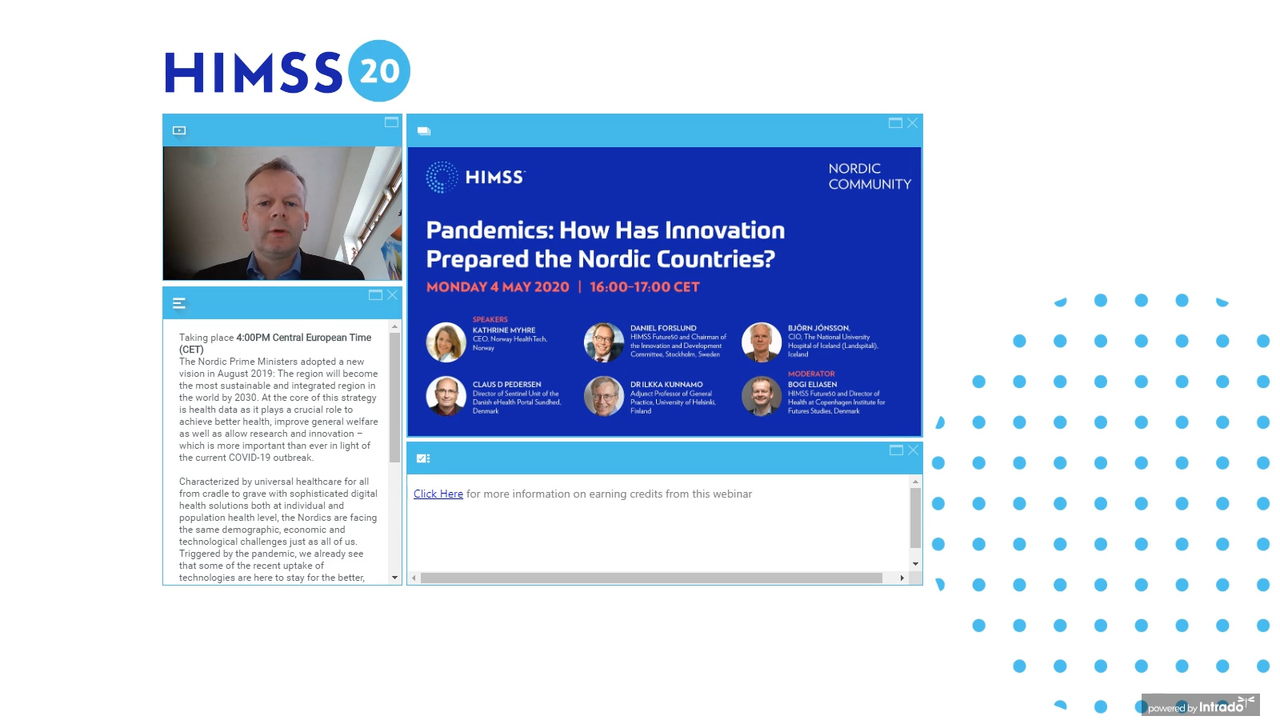
The maturity of the Nordic healthcare model means that the time is ripe to focus on predictive care, while lowering the costs to patients and improving efficiency for providers, says Jan E. Larsson, SVP at Cambio Healthcare Systems.
Finland and Estonia use X-Road, software that enables secure exchange of data, and there are opportunities to expand to the rest of Europe, says Petteri Kivimäki, CTO for Nordic Institute for Interoperability Solutions.